
Building a secure retirement starts with understanding the tools available to you. One of the most powerful and widely used retirement vehicles is the Individual Retirement Account (IRA). When used correctly, an IRA can provide significant tax advantages, long-term growth potential, and flexibility in how you invest for the future.
This guide explains what an IRA is, how it works, the different types available, and how to use one effectively as part of a long-term retirement strategy.

What Is an IRA and How Does It Work?
An Individual Retirement Account (IRA) is a tax-advantaged savings account designed to help individuals prepare financially for retirement. Unlike standard savings or brokerage accounts, IRAs offer special tax benefits that allow your money to grow more efficiently over time.
At its core, an IRA allows you to contribute money each year, invest those funds, and let them grow over the long term. Depending on the type of IRA you choose, your contributions may reduce your taxable income today, or your withdrawals in retirement may be tax-free.
IRAs work by combining three essential elements: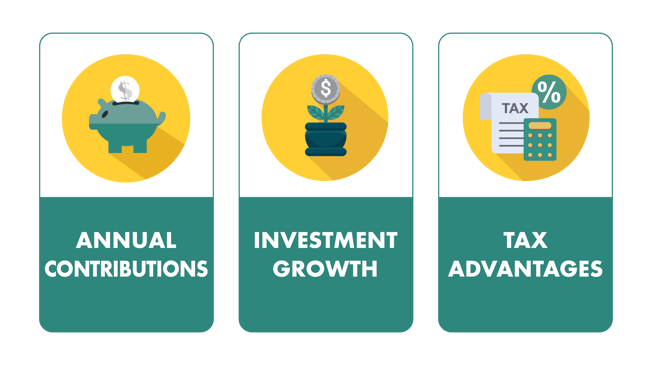
- Annual Contributions – You fund the account within IRS-defined limits.
- Investment Growth – Your contributions are invested in assets such as stocks, bonds, mutual funds, ETFs, or other eligible investments.
- Tax Advantages – Growth occurs tax-deferred or tax-free, depending on the IRA type.
Because taxes do not erode your gains year after year, IRAs allow compounding to work more effectively, which can significantly increase your retirement savings over time.
Types of IRAs: Traditional vs. Roth
The two most common types of IRAs are the Traditional IRA and the Roth IRA. While both are designed for retirement savings, they differ primarily in how and when taxes apply.
Traditional IRA
A Traditional IRA allows you to contribute pre-tax dollars, meaning your contributions may be deductible from your taxable income in the year you contribute. This can lower your current tax bill.
Key characteristics:
- Contributions may be tax-deductible
- Investments grow tax-deferred
- Withdrawals in retirement are taxed as ordinary income
- Required Minimum Distributions (RMDs) begin later in retirement
This structure is often appealing to individuals who expect to be in a lower tax bracket during retirement than they are today.
Roth IRA
A Roth IRA is funded with after-tax dollars. You do not receive a tax deduction for contributions, but the long-term benefit is substantial.
Key characteristics:
- Contributions are made after taxes
- Investments grow tax-free
- Qualified withdrawals in retirement are tax-free
- No required minimum distributions during the owner’s lifetime
A Roth IRA can be particularly valuable for those who expect higher tax rates in the future or who want greater flexibility in retirement income planning.
IRA Contribution Limits and Rules
Understanding IRS rules is critical to using an IRA effectively.
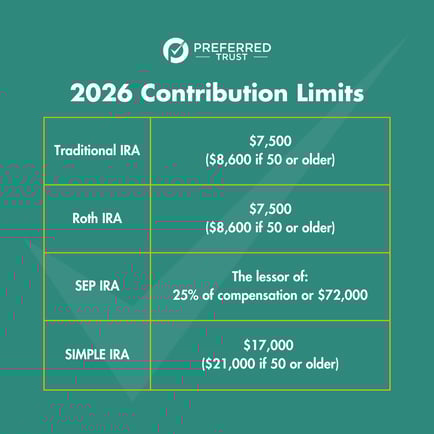
Contribution Limits
Annual contribution limits are set by the IRS and may change over time. Individuals over a certain age are allowed additional “catch-up” contributions to help accelerate retirement savings as they near retirement.
Income Limits for Roth IRAs
Roth IRAs have income phase-outs. High-income earners may be limited or unable to contribute directly, although strategies such as Roth conversions may still be available.
Required Minimum Distributions (RMDs)
Traditional IRAs require account holders to begin taking minimum distributions later in life. These withdrawals are taxable and must follow IRS schedules. Roth IRAs do not have RMDs for the original owner, allowing assets to continue growing tax-free.
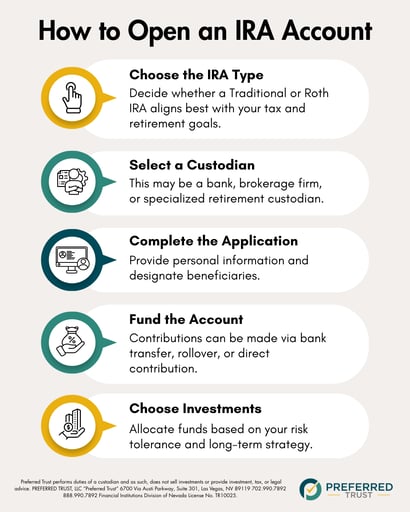 How to Open an IRA Account
Opening an IRA is a straightforward process.
- Choose the IRA Type – Decide whether a Traditional or Roth IRA aligns best with your tax and retirement goals.
- Select a Custodian – This may be a bank, brokerage firm, or specialized retirement custodian.
- Complete the Application – Provide personal information and designate beneficiaries.
- Fund the Account – Contributions can be made via bank transfer, rollover, or direct contribution.
- Choose Investments – Allocate funds based on your risk tolerance and long-term strategy.
Many providers offer automated contributions, making it easier to save consistently.
What is the Difference between an IRA vs. a 401(k)?
While both accounts are designed for retirement, IRAs and 401(k)s differ in important ways.
Sponsorship
- IRA: Opened and funded by an individual
- 401(k): Sponsored by an employer, often with matching contributions
Contribution Limits
401(k)s allow for significantly higher annual contributions than IRAs, making them powerful tools for high earners or aggressive savers.
Investment Control
IRAs typically offer broader investment flexibility, while 401(k)s are limited to options selected by the employer or plan administrator.
For many individuals, using both an IRA and a 401(k) together creates a more balanced and tax-efficient retirement strategy.
Why Early Retirement Planning Matters
Time is one of the most powerful factors in building retirement wealth. Starting early allows compounding to work longer and reduces the pressure to save aggressively later in life.
Early planning also provides:
- Greater flexibility in investment choices
- More resilience during market downturns
- The ability to adjust strategies gradually over time
Even modest contributions made early can outperform larger contributions made later due to the long-term compounding effect.
Frequently Asked Questions About IRAs
 Can I have both a Traditional and Roth IRA?
Yes, but total annual contributions across all IRAs cannot exceed IRS limits.
What happens if I exceed contribution limits?
Excess contributions may be subject to penalties unless corrected promptly.
Can I withdraw funds early?
Early withdrawals may trigger taxes and penalties, though certain exceptions exist for qualified expenses.
Conclusion: Making the Most of Your IRA
An IRA is one of the most effective tools available for long-term retirement planning. Whether you choose a Traditional IRA for immediate tax benefits or a Roth IRA for future tax-free income, understanding how these accounts work empowers you to make smarter financial decisions.
The key principles remain consistent:
- Start early
- Contribute regularly
- Invest strategically
- Understand the rules
With thoughtful planning and disciplined execution, an IRA can play a central role in building financial security and confidence throughout retirement.