
As you plan your retirement savings strategy for 2025 and beyond, it is important to understand how contribution limits are changing and how Preferred Trust Company helps you take full advantage of these increases.

What Has Changed: Key Limits for 2026 and 2025
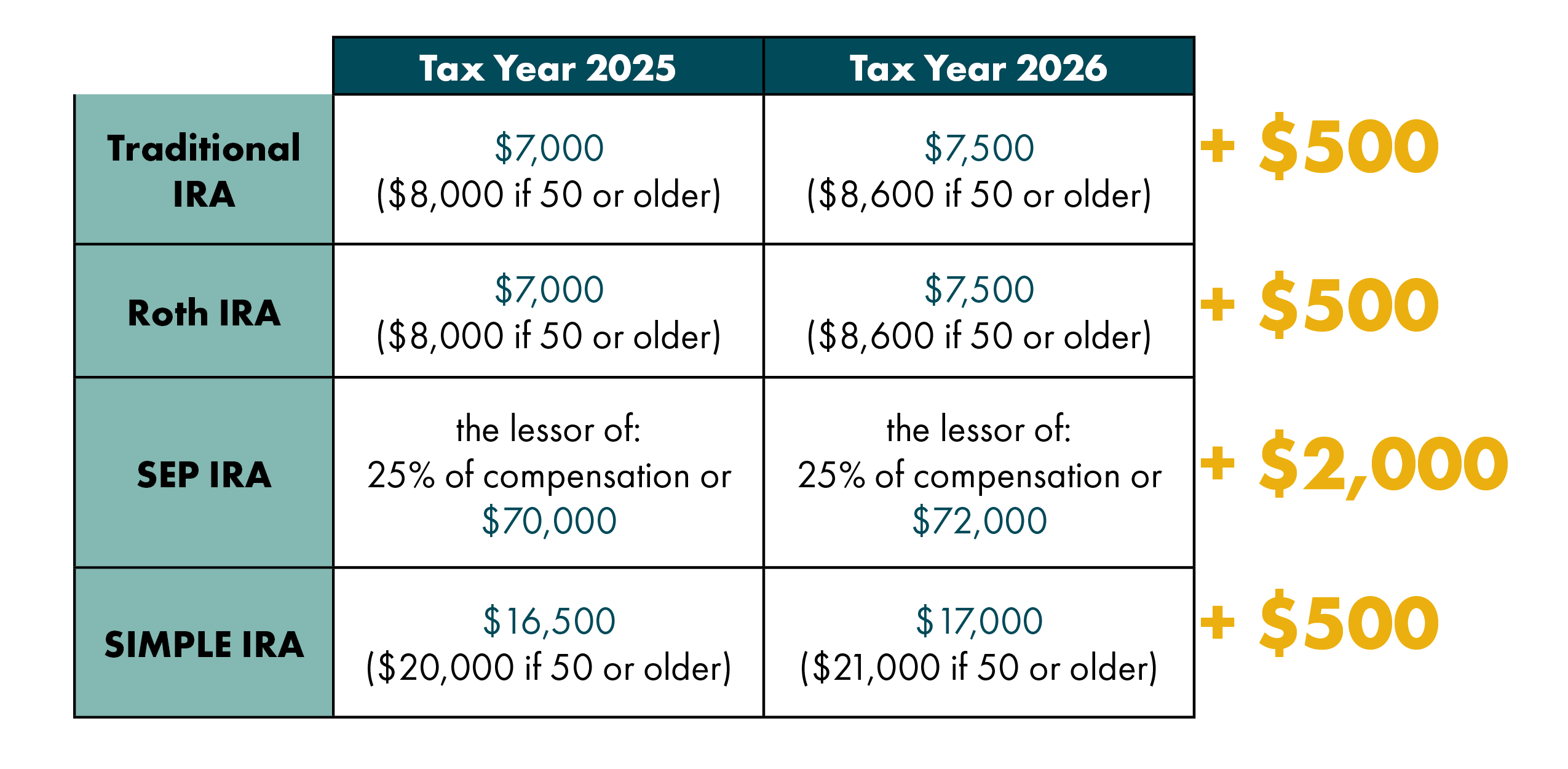
The IRS has announced cost-of-living adjustments for retirement plan and IRA contribution limits. Here are the most relevant updates based on the published IRS contribution chart.
- The annual contribution limit for Traditional and Roth IRAs increases to $7,500 for 2026, up from $7,000 for 2025.
- Individuals age fifty and older may contribute an additional $1,100 as a catch-up contribution for 2026.
- The elective deferral limit for 401k, 403b, and most 457 plans rises to $24,500 in 2026.
- The annual compensation limit for defined contribution plans increases to $360,000 in 2026.
These updates allow savers to place more money into tax-advantaged retirement accounts each year.
Why the Limits Rise: Understanding the Adjustments
You may wonder: why do the contribution limits go up? Here’s the breakdown:
- Cost-of-Living / Inflation Adjustments
The IRS indexes many retirement plan limits to measures of inflation or wage growth. These annual adjustments ensure that the value of retirement tax incentives does not erode over time. The increases you see for 2026 are consistent with historic practice. - Legislative & Regulatory Changes
Occasionally, Congress enacts laws (or regulatory guidance is issued) that affect retirement plan limits, catch-ups, eligibility rules, and Roth requirements. For example, catch-up provisions for certain age bands have been expanded in recent years. - Encouraging Retirement Savings
By raising contribution limits, the system gives savers a greater opportunity to shield more income for retirement with favorable tax treatment. From the perspective of Preferred Trust and our clients, these increases represent added flexibility and potential for growth.
Action Steps: What You Should Do Now
To make the most of the higher limits and your IRA with Preferred Trust, consider these steps:

Review your compensation and savings eligibility: Ensure you have sufficient earned income (or spousal compensation if applicable) to support max contributions.

Decide whether Traditional or Roth is best for you: With higher limits, the choice between tax-deductible (Traditional) vs. after-tax (Roth) contributions becomes even more strategic.

Maximize contributions early in the year: Taking advantage of the full contribution limit sooner gives your money more time to grow.

Consider your investment plan: With higher contribution limits, plan how you’ll deploy the funds. Diversify your investment portfolio by considering alternative assets that align with your risk profile.
Stay compliant with IRS rules: More savings means more importance on correct documentation, prohibited transaction avoidance, and timing. Preferred Trust is here to help you stay in compliance.
Reassess annually: Because limits can change year-to-year (as they did for 2026), plan to revisit your contribution strategy each year.
Final Thoughts
The 2026 contribution limit increases create valuable opportunities for individuals who want more control over their retirement planning. For Preferred Trust account holders, these adjustments mean more funding capacity, more diversification, and more potential for long-term tax-advantaged growth.
Learn More About the New Retirement Account Limits
If you would like to review the full IRS contribution chart for 2026, including all plan types and compensation limits, you can find the complete publication here.